40 lessons from my first post-course twinset dive
Prologue
I don’t have many regrets as a diver, but one that sits at the top of the list for me is not accumulating enough experience in open circuit technical diving prior to diving on a rebreather. Whilst in Gili Trawangan training with one of the world’s premier JJ-CCR instructors, he advised me to spend a good few months getting the hang of a twinset and filling in the gaps I had as an open circuit diver. Buoyed by his advice, I decided to do an unorthodox approach, where I would do two different courses spread out over a month. The first course would be a GUE Doubles Primer course in my hometown of Sydney, while the second course would be a TDI Advanced Nitrox & Decompression Procedures course in Altona, Victoria. The logic behind this is that I wanted to get familiar with a twinset in shallow water before progressing to deeper, colder water to train as a technical diver. I also wanted to make up my mind as to which agency was better for me - GUE or TDI?
Unfortunately, the Doubles Primer I did was nothing short of an unmitigated disaster. To make a long story short, the combination of an arrogant instructor, a subpar classmate, cold murky water, and strong currents all made for one of the worst experiences I had had as a student of diving. I passed the course, but there was absolutely nothing pleasurable about it. Fortunately, now that I had experience and a card proving it, I now felt more confident accompanying some friends of mine who were veteran GUE divers for a shore dive the next day. While that dive was not nearly as disastrous as the one on my course, there were a lot of lessons I learned that day - perhaps even more than during my course - that were either directly told to me by my buddies, or silent observations I picked up throughout the day. In writing this, I would like to clearly state that my position is strictly agency-agnostic, and I am merely sharing my experience for divers considering going down the technical diving route.
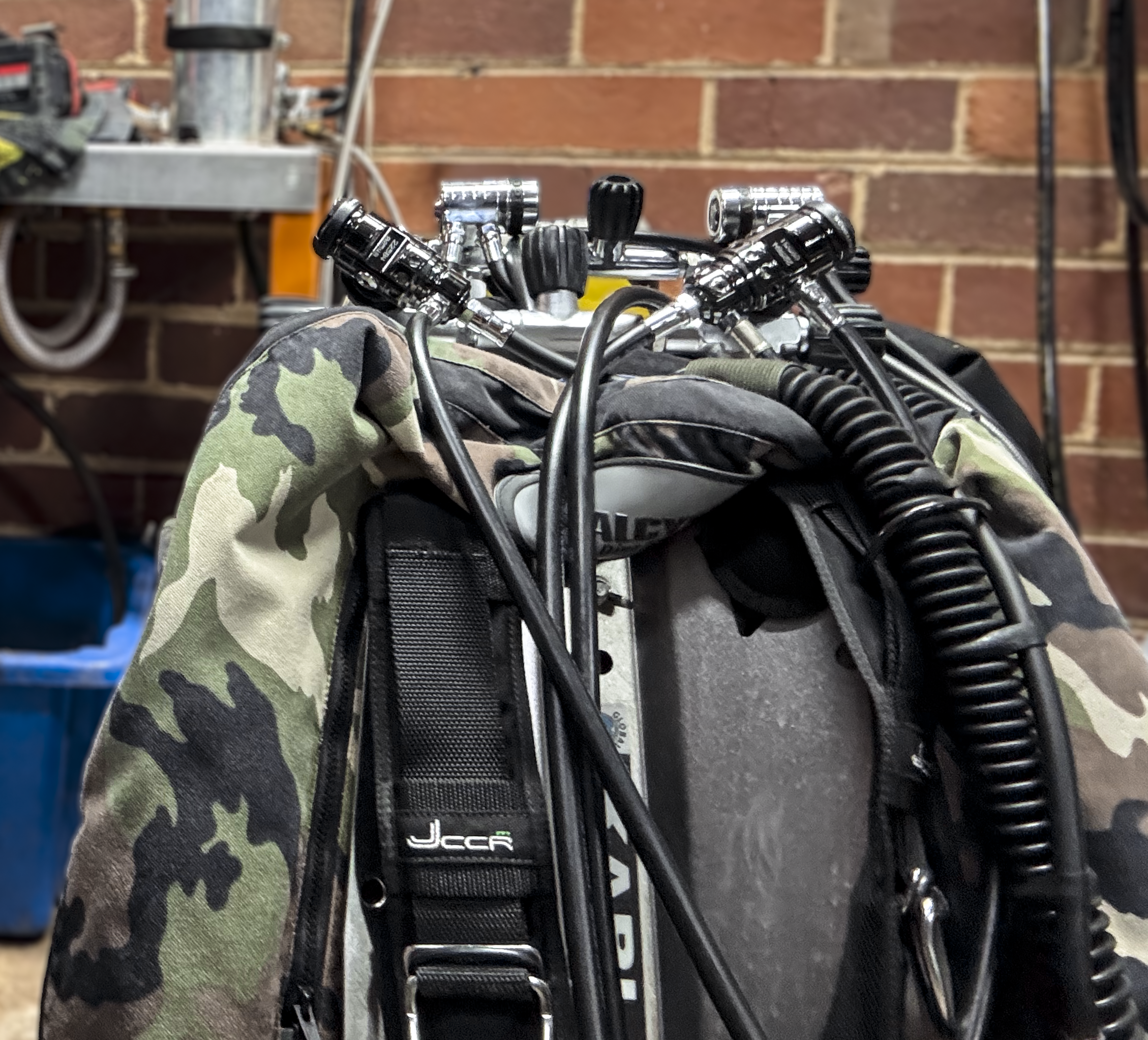
One of the many twinsets I borrowed during my open circuit training
Before the dive
If you’re shore diving with GUE divers, don’t use 21% as your back gas. Instead, use the GUE standard gas of 32% Nitrox - not only does the higher percentage of O2 work in your favour, but it ensures consistency and uniformity across GUE divers.
The disadvantage of borrowing and/or renting equipment is that it may have problems, such as a burst SPG hose, too thin a space between tanks for weights, and a harness that might not fit quite right. This is especially problematic for technical divers.
If you do need extra weight for a twinset, put it towards the back to counterbalance the top-heavy nature of the manifold and tanks.
Hip pockets aren’t good for your trim, even in recreational diving on a single tank. In twinset diving, it interferes with the hip D-rings and light canister. When you need extra weights in a twin tank configuration, always try to keep them between the tanks using a V weight pouch.
Your harness needs to be adjusted perfectly to suit you and you alone.
When getting your drysuit on, put your drysuit powder on the neck seal from the inside.
Always put your hood on before you put your two regs on, so that the necklace bungee sits on top of your hood.
Low visibility isn’t technically an environmental hazard, but it can cause problems. That said, it is a good opportunity to practice situational and team awareness, and the resilience that comes with it.
Check whether your buddy’s primary light is working as you get in the water. Realising it doesn’t work until too late into the dive is not fun at all!
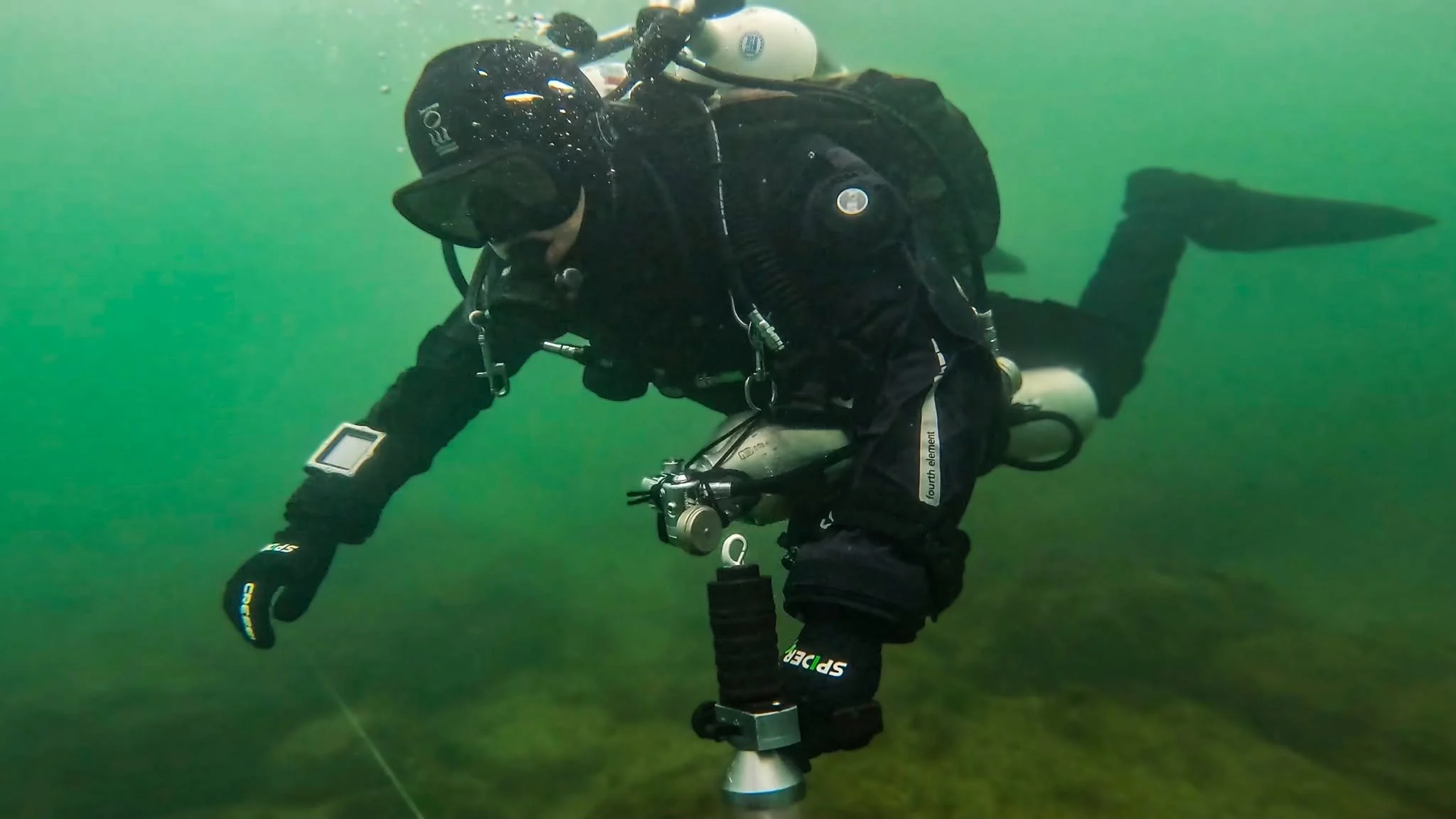
Photo credit: Karl Graddy
During the dive
When entering the water, if you have time, close your suit dump valve, inflate your suit, move around comfortably, and stretch. Open the dump valve, and expel all the air out.
Your drysuit should not be thought of as a buoyancy control device. Your wing should always be your primary buoyancy control device in open circuit, and second only to your loop volume for rebreather diving.
Swimming side by side versus single file is dictated by the environment and the team’s pre-dive goal. All members of the team may change their positions for a variety of reasons during a dive. Don’t make a concrete rule about this and stay open to adapt on the fly. Team positioning should be logical and dynamic as required during a dive.
As a member of a team, it’s every diver’s responsibility to be aware of their team and position themselves such that they can all work together. Bumping into each other isn’t ideal, but not a dealbreaker either. Whatever the case, it can be difficult on mixed teams, where the stealthiness of CCR divers can make it hard to detect them.
If you are negatively buoyant due to a combination of heavy legs and bad gear configuration, you will almost certainly kick up the silt.
When inflating an SMB whilst on OC, try not to disconnect your drysuit hose, because it can create an entanglement hazard, meaning you will get dragged up with the SMB if things go awry. Try to orally inflate the SMB when on OC and a drysuit.
When you’re underwater, breathe normally just like you’re laying down in your bed. Don’t try to change your breathing pattern or speed while diving. Being neutrally buoyant and diving with a “balanced-rig” will have a huge contribution to your breathing rate.
The beginning of a CO2 hit can increase paranoia, so if you’re feeling agitated, try to tell your brain that’s just CO2 playing tricks on your mind, slow down, and make sure you are breathing normally.
If you’re diving on a mixed team and your CCR buddies are switching their set points or messing around with computer settings, don’t say anything other than the okay signal, as it’s distracting and unnecessary. Only do it if there is a genuine problem that needs attention.
If you’re uncertain about your skills, practice in a bay where there is no current. If you are feeling ready for current practice, go to a bay with more pronounced currents when it feels right for you.
If you can hear a roaring boat engine from afar, but you’re deep down and have no intention of surfacing, that’s not cause for panic.
The correct hand signal to indicate a strong current is an oscillating hand that moves like a snake.
Always try to do your ascents in trim, and make sure you are regularly dumping your wing and suit gas rather than in one big go when it’s too late.
If you are ascending along a line that is on an angle due to a current, make sure you are side by side, because of how much of a pain in the ass it is trying to swim around in a triangle/star shape. Face to face deco ascents should be only done if there is no current.
It is practically impossible to do a reverse kick unless you are in trim. Take your time when doing this, or else doing it in an out-of-trim position will get you nowhere and give you a cramp.
When descending down along a line, regularly do small inflations of your wing and drysuit, rather than doing it in one big go at irregular intervals.
When you hit the descent point, that is the only time you should inflate your drysuit, ideally. As you slowly ascend, dump it incrementally.
Be calm and slow with your hand signals, and don’t over communicate. Remember that having black gloves can exacerbate the difficulty of interpreting signals, so take your time out of respect to your buddies.
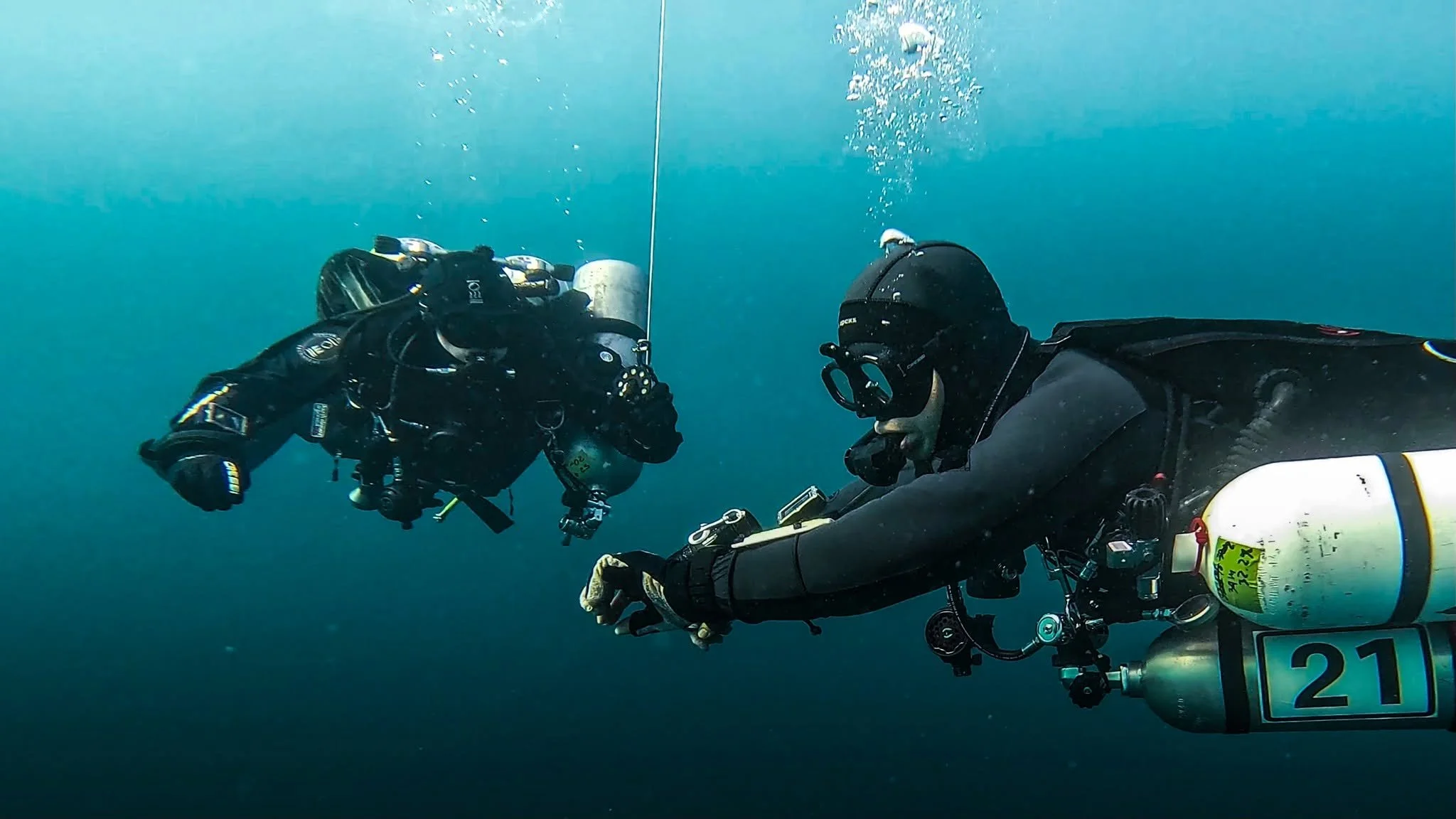
Photo credit: Karl Graddy
End of the dive
If you’re tired and on edge after a long dive, your panic will slyly hijack your brain to make you want to rush, so take it easy, not just for yourself, but also to see whether you’ve outswam your buddies and left them behind. If you are the diver managing the SMB, stop and see whether they are swimming by your side or behind you.
If your foot pockets are accumulating too much air, go out of trim, deflate your BC and let it all out. You will feel a squeeze, so make sure you have the bare minimum, and then inflate your BC back to where it was. Managing your drysuit should be a proactive, continuous process that, again, is separate from managing your wing and buoyancy.
Try to avoid scissor kicking unless the current is really strong - that is a telltale sign of an agitated, rushing diver.
If you are tired, communicate to your buddies that you need to rest to get your breathing back down and to relax,
If you’re responsible for performing a task (leading the deco, being in charge of navigation, deploying SMB, etc), don’t bail out without any reason and no communication. Either take full responsibility for the task or for whatever legitimate reason if you can’t perform the task, make sure you clearly communicate with the team to ensure someone’s happy to take over your responsibility and continue.
Never ever lose sight of your buddies. If for whatever reason you are swimming faster than your buddies (which is a residual side effect from recreational diving), you will likely lose them if the vis is bad, so swim slowly and closely together.
When shore diving, uneven sand dune patterns can make it easy to lose your direction, and swim deeper, so use your computer’s compass when that happens.
If you are separated during a shore dive, search for 5 minutes and attract attention underwater, and if there is no sign, return to the shore and wait for them.
No matter how badly you want to swim back to the surface, always slow everything down and never rush. Remember, slow is fast, and fast is slow.
How calm and collected you are on the surface before, during and after the dive whilst talking with your buddies is an indicator of your mindset/relaxation.
If you have paid for a second dive later in the day, or worse, a technical dive after a shore dive, and you are feeling lazy/tired/not up for it, don’t do it. Take the small financial hit - it’s not worth a DCS hit.
Always rehydrate immediately after a dive.
Although extremely unlikely, there is always a tiny chance you can get bent from excessive physical exertion after you surface and make your way back to the boat/carpark (ie climbing a ladder, carrying too many stages, walking too far).
When I re-read all 40 of these lessons, it’s surprising how many of them apply to professional and personal life too! Obviously not all of them, since there are some tips that are extremely specific to diving. But, to quote my friend Jill Heinerth - diving is a metaphor for life.